city-journal.org · September 8, 2026
Iowa’s University Reforms Show the Way Forward
Mark Bauerlein
# Iowa’s University Reforms Show the Way Forward
Legislators in the Hawkeye State are rolling back DEI and rewriting general education requirements to include U.S. history and government.
September 08, 2026 / Share
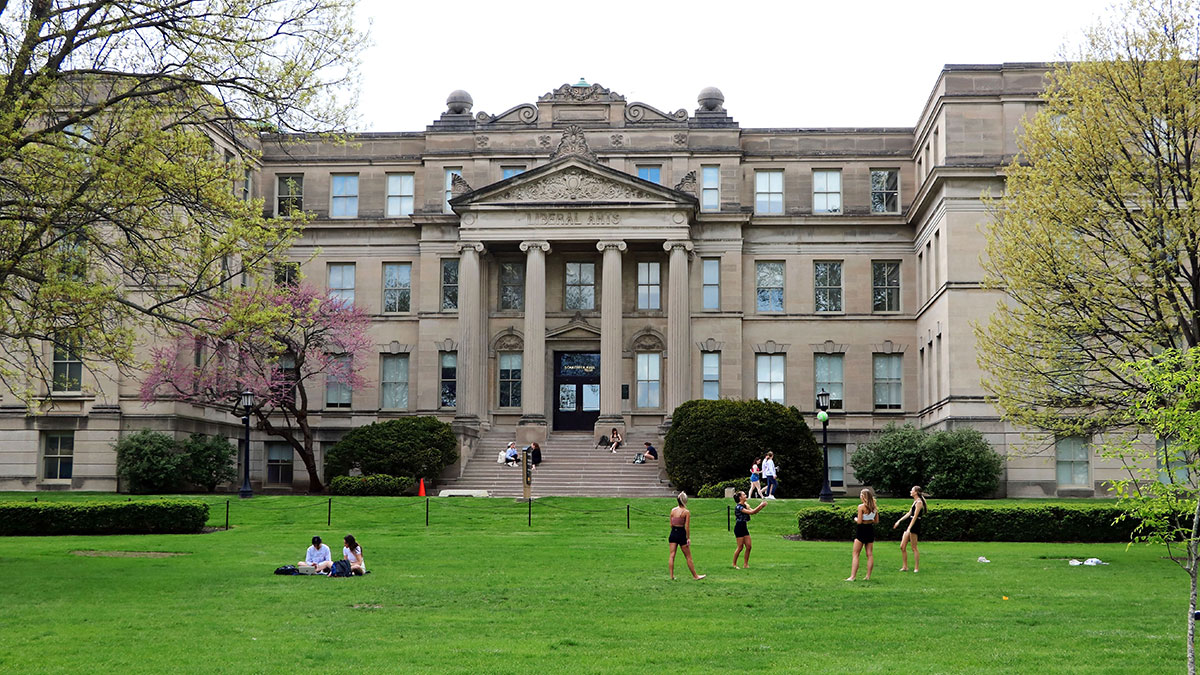
Photo by: Don and Melinda Crawford/UCG/Universal Images Group via Getty Images
/ Eye on the News / Education Sep 08 2026 / Share
In early June, Iowa’s state legislature passed a bill mandating that all university students take two courses, one in U.S. history and one in government, to meet general education requirements. The courses must be broad enough to count as introductory surveys— no special topics or advanced studies may qualify—and restrictions govern who can craft and run them.
Politicians in the Hawkeye State took this step because general education at public colleges and universities is a sprawling market of a thousand options, from which each student crafts a custom education. At the University of Iowa in Iowa City, a freshman can take “Black Television Culture” or “Native American Foods and Foodways” to meet the Understanding Cultural Perspectives requirement. At Iowa State University in Ames, “Racism in American Popular Culture” and “French and Francophone Animation” fulfill the Arts and Humanities requirement. The University of Northern Iowa has a Human Condition (Domestic & Global) requirement that students can meet with courses such as “People of the Great Lakes,” “Global Skills,” or “Introduction to LGBTQ+ Studies.” When the law goes into effect in 2028, students in Iowa’s four-year institutions will no longer be able to meet their history- and civics-related requirements with such boutique and ideological offerings.
“Iowa makes history and civics great again,” wrote State Representative Taylor Collins, the legislation’s main author. Ignorance of U.S. history and civics among American adults is “shocking,” he added, citing Iowa schools’ “Absurd options” for general education requirements that are “far removed from a true liberal arts education.” Collins spoke in similar terms when we met at a gathering in Iowa City last year to talk about higher education. His was not the language one usually hears local officials apply to top public institutions in their states.
Collins, 30, is in his second term in the Iowa House of Representatives. Remarkably, in addition to authoring such important legislation, he already chairs the Higher Education Committee. Ten years ago, he was an undergraduate at Iowa State, majoring in business and minoring in political science while serving as president of the College Republicans. He fulfilled the state’s general education requirements with courses in sexuality and global studies, “which were a big waste of time,” he told me in one of four subsequent interviews.
“I always wanted to go into politics,” he said. So he proceeded to law school after graduation but lasted only a week before dropping out and enlisting in Kim Reynolds’s campaign for governor. He joined the Reynolds administration after her win, working for the lieutenant governor as an aide and speechwriter, but he found the internal politics in Des Moines unsatisfying, especially after Covid-19 hit in early 2020. He returned to his home county and learned that the local representative was retiring in 2022. He wound up running uncontested, taking a seat in the lower chamber in January 2023.
Soon after, Collins found himself charged with moving an anti-DEI bill through the House. Collins doesn’t say so explicitly, but his outspokenness likely helps explain why such a controversial endeavor was entrusted to a twentysomething freshman member. Many Republicans who attended Iowa schools still “romanticize them,” he told me. They have a hard time accepting that the campuses they fondly remember no longer exist. Others resist meddling in college affairs because they believe in limited government. Collins considers this attitude “a great gift to university leaders and the crazies on campus.” Some Republicans still worry about bad press, but “unless you’re getting attacked,” he laughs, “you’re probably not doing your job.”
The young upstart took the lead on the initiative—and the heat. When Collins put the proposal forward, reaction was swift. Iowa Democrats and school leaders warned that the anti-DEI bill would hamper the recruitment of students and faculty and hurt needy students, and threaten accreditation, too. Collins responded by citing accounts of “privilege walks” and other DEI practices, along with the hefty annual salaries of DEI officers, more than $750,000 in four cases, he reported.
Collins’s colleagues were persuaded. The bill stalled for a year but was signed into law in May 2024. Apart from ensuring “colorblind admissions and hiring,” the law prohibits:
> any effort to promote, as the official position of the public institution of higher education, a particular, widely contested opinion referencing unconscious or implicit bias, cultural appropriation, allyship, transgender ideology, microaggressions, group marginalization, antiracism, systemic oppression, social justice, intersectionality, neo-pronouns, heteronormativity, disparate impact, gender theory, racial privilege, sexual privilege, or any related formulation of these concepts.
Collins credits the Manhattan Institute with helping to compile this list. He suggests another factor that helps explain why woke practices persist even at universities in solidly red states. “Some of my colleagues are much older than I am, and they come from rural areas where nobody talks this way,” he explains. They don’t know what “heteronormativity” and “intersectionality” mean and can hardly believe it when told that such notions are now core dogma in the humanities and social sciences. Asking longtime Republican legislators from farming and small-town districts to reform the university—to expel the insidious ideology of identity politics—is like sending green recruits to far-off lands to battle veteran guerrillas.
Collins went to great lengths to help spread the word to fellow lawmakers. He produced a glossary of woke terms and distributed it to potential allies in the House, and collected slideshows from the University of Iowa’s DEI office that shocked members when they saw merit-based judgments cast as a form of white supremacy. Collins’s colleagues shared his irritation that this was going on at taxpayer expense, and that college officials were telling legislators that they shouldn’t do anything about it.
The debate over the anti-DEI bill continued in the press. A Democratic colleague in the House stated on Iowa Public Radio that “diversity” merely means “people different from you,” while “equity” signifies fairness, and “inclusion” is just a matter of “welcoming women . . . people of color, the LGBTQ community. . . . I don’t know what’s so scary about that.” Another Democrat called the bill “a deliberate choice to structure society in a way that benefits only one particular group while denying opportunity to others.” A member of the Iowa Legislative Black Caucus said the bill was about “censorship, exclusion, and erasing important conversations that prepare students for the real world.” The caucus issued a separate letter to colleagues calling DEI a “moral obligation.”
Collins responded forcefully to these contentions. DEI programs are “ideological enforcement centers that suppress the pursuit of truth, and most importantly, merit,” he said. He spoke of DEI as a “radical program,” called gender studies and social justice majors “garbage degrees,” and sent a letter to presidents of the three state universities that concluded, “Clear and decisive action from each of you is the only way we can ensure that DEI is DOA in the State of Iowa.”
His critics did have a point, however, when they warned that accreditation was a concern. In 2024, the accreditor of Iowa’s institutions, the Higher Learning Commissio