This week, state superintendent Debbie Critchfield and Idaho’s colleges and universities turned in no-frills budget requests for 2027-28. There will still be budget debates next legislative session — just on the margins.
Idaho Ed News · Kevin Richert · September 3, 2026
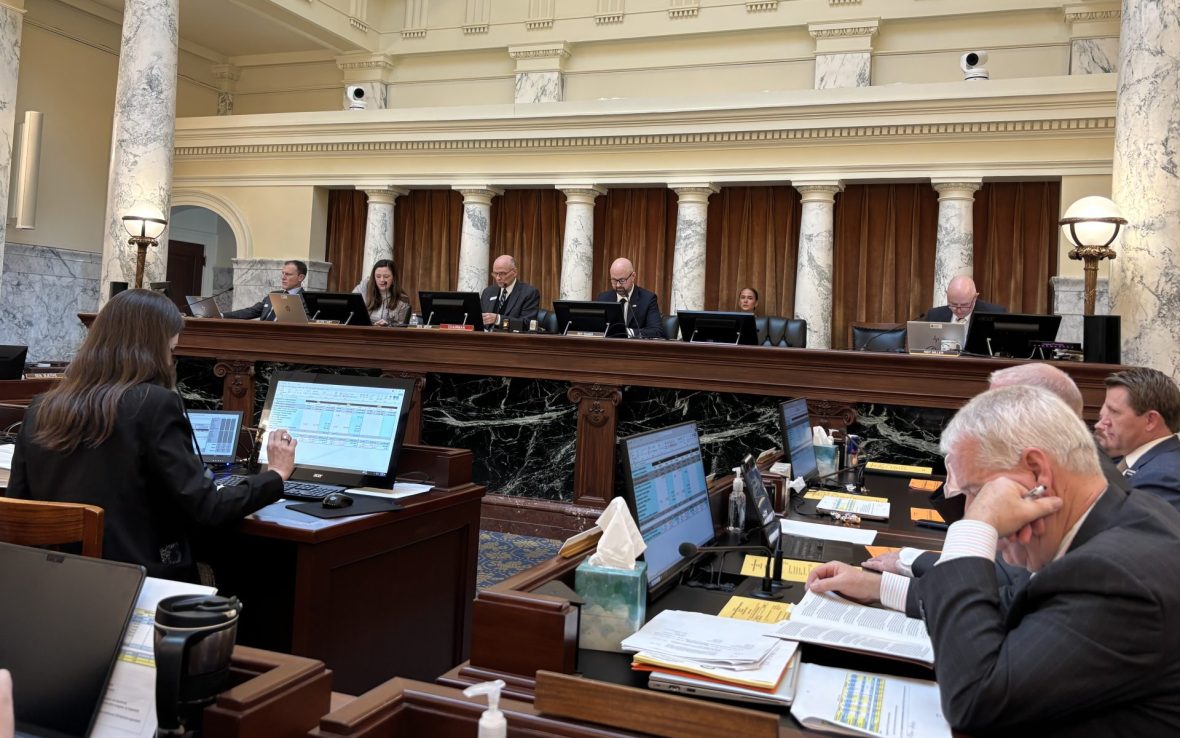
It’s still 130 days until the start of the 2027 legislative session. (Trust me, I keep track.)
So it’s, roughly, 220 days or so until the end of the next session.
But trust me on this as well: Here’s how it’s going to go. Look for a whole lot of fighting on the fringes of a state budget approaching $6 billion. A lot of haggling over — and yes, this is a relative statement — dollars on the margins.
State superintendent Debbie Critchfield and Idaho’s colleges and universities turned in their 2027-28 budget requests this week. And, no surprise, they’re pretty much no-frills stuff. In May, Gov. Brad Little directed state agencies to turn in maintenance-only budget requests . Education leaders stuck close to the memo.
But there will be budget debates on the margins, and they’re important. They will matter for Idaho’s most at-risk K-12 students. They will matter for college and university students — who are having to shoulder an increased share of the cost that comes with enrollment growth. And they will matter for taxpayers, because even on the margins, we’re still talking about multimillion-dollar spending decisions.
Critchfield’s big budget request — and her big play for 2027, should she be re-elected in November — can be found in one $20 million line item. She wants to put more money into operational funding for schools. The operational line item is sometimes labeled “discretionary” spending, much to the chagrin of school administrators who lean heavily on this money. By any name, districts and charters can use the money wherever they feel they need to: to bolster salaries, hire staff, or purchase textbooks or technology.
State superintendent Debbie Critchfield speaks during a listening session at the College of Eastern Idaho on June 11, 2026. (Devin Bodkin/Idaho EdNews)
" data-large-file="https://www.idahoednews.org/wp-content/uploads/2026/06/IMG_1471-1180x885.jpg" class="wp-image-121387 size-large" src="https://www.idahoednews.org/wp-content/uploads/2026/06/IMG_1471-1180x885.jpg" alt="" width="1180" height="885" srcset="https://www.idahoednews.org/wp-content/uploads/2026/06/IMG_1471-1180x885.jpg 1180w, https://www.idahoednews.org/wp-content/uploads/2026/06/IMG_1471-620x465.jpg 620w, https://www.idahoednews.org/wp-content/uploads/2026/06/IMG_1471-200x150.jpg 200w, https://www.idahoednews.org/wp-content/uploads/2026/06/IMG_1471-1536x1152.jpg 1536w, https://www.idahoednews.org/wp-content/uploads/2026/06/IMG_1471.jpg 1920w" sizes="auto, (max-width: 1180px) 100vw, 1180px" /> State superintendent Debbie Critchfield speaks at a K-12 funding formula listening session at the College of Eastern Idaho on June 11, 2026. (Devin Bodkin/Idaho EdNews) And in that same vein, Critchfield is counting on that $20 million to do a lot of lifting. She’d like it to cover years of inflationary neglect, as lawmakers have kept the operational payments frozen. She’d also like to use it to patch up the potholes on the road to a rewritten K-12 funding formula — helping schools that would lose some state funding if Idaho moves to an enrollment-based formula that provides more money to those with higher numbers of at-risk students.
There’s no guarantee $20 million will be enough to smooth out a funding formula transition.
Lawmakers haven’t had a chance to act on this $20 million request, and it already feels like the money is wearing thin.
The $20 million is a departure from Little’s maintenance-only edict, said Gideon Tolman, Critchfield’s chief operating officer. “We feel like we are at a critical point with the funding formula. We’ve got to do something, and so we’re putting some funding toward that and saying, ‘Let’s get moving.’”
There are political risks and tradeoffs, of course. One tradeoff involves Critchfield’s top priority from the 2026 legislative session . Critchfield secured support for a new fund for schools with “high-needs” special education students who need full-time staff support or costly medical care.
Lawmakers said yes to a $5 million program. Next year, Critchfield wants $1.7 million.
Critchfield’s office bristles at the suggestion that this is a cut. Critchfield used interest and carryover from two in-house accounts to scrounge together this year’s $5 million. Now, only $1.7 million is left over in these two funds.
Fair enough. But budgets reflect priorities and attach cold numbers to them.
Critchfield is putting all of her chips on her $20 million request, hoping to finally facilitate a funding formula rewrite that might provide added support for special education students. However, she is also wagering that the high-needs program — a new initiative with no track record — can get by on about a third of its first-year budget. And she’s doing that after she has already said the $5 million will be “gone in a minute.”
Idaho’s $100 million special education shortfall — that yawning gap between state and federal funding and local costs — looms much larger than the dollars that are up for debate.
Meanwhile, a famished higher education system is hoping to cut some of its recent losses, in the sum of $13.5 million.
The biggest higher education line item is nearly $12.2 million for “enrollment workload adjustment,” or EWA. Like the K-12 funding formula, unchanged since 1994, EWA is a complicated construct. In summary — and this is actually dumbing it down — EWA uses a three-year rolling average of weighted credit hours to offset the cost of rising enrollment.
Except this year, that is, when Little zeroed out EWA and told the colleges and universities to accommodate more students with fewer state dollars. Predictably enough, the State Board of Education responded in April, approving the largest set of tuition increases since 2023 at Idaho’s four-year schools.
David Hahn, the sole finalist for the Boise State presidency, speaks to reporters in a Tuesday, June 16, 2026 press conference. (Kaeden Lincoln/EdNews)
" data-large-file="https://www.idahoednews.org/wp-content/uploads/2026/06/davidhahnpresser1-1180x787.jpg" class="wp-image-121741 size-large" src="https://www.idahoednews.org/wp-content/uploads/2026/06/davidhahnpresser1-1180x787.jpg" alt="" width="1180" height="787" srcset="https://www.idahoednews.org/wp-content/uploads/2026/06/davidhahnpresser1-1180x786.jpg 1180w, https://www.idahoednews.org/wp-content/uploads/2026/06/davidhahnpresser1-620x413.jpg 620w, https://www.idahoednews.org/wp-content/uploads/2026/06/davidhahnpresser1-200x133.jpg 200w, https://www.idahoednews.org/wp-content/uploads/2026/06/davidhahnpresser1-1536x1024.jpg 1536w, https://www.idahoednews.org/wp-content/uploads/2026/06/davidhahnpresser1.jpg 1920w" sizes="auto, (max-width: 1180px) 100vw, 1180px" /> Boise State University President David Hahn speaks to reporters at a June 16, 2026 press conference. (Kaeden Lincoln/EdNews) While Boise State University is approaching “record territories of growth” — in terms of enrollment and research — the EWA funding is a formulaic approach to paying the bills that come with increased student numbers, new President David Hahn said. “Hopefully, we all rally behind EWA,” Hahn told EdNews Monday.
With enrollment increasing across the higher ed system , all eight of Idaho’s colleges and universities stand to get a share of EWA funding. For Boise State, however, the stakes are highest. The formula would yield nearly $5.3 million for the university — allowing it to hire 18 faculty members in high-demand fields.
While $5.3 million is no small sum of money, let’s keep it in context.
Boise State’s annual budget runs just north of $300 million.
And after two rounds of state budget cuts that took an outsized slice out of higher ed , the $5.3 million won’t make Boise State whole. Earlier this year, interim President Jeremiah Shinn said those cuts came to about $16.5 million .
State Budget Director Lori Wolff speaks at a press conference on Monday, Jan. 12, 2026, at the Statehouse. (Sean Dolan/EdNews)
" data-large-file="https://www.idahoednews.org/wp-content/uploads/2026/01/IMG_3214-1180x790.jpg" class="wp-image-112609 size-large" src="https://www.idahoednews.org/wp-content/uploads/2026/01/IMG_3214-1180x790.jpg" alt="" width="1180" height="790" srcset="https://www.idahoednews.org/wp-content/uploads/2026/01/IMG_3214-1180x790.jpg 1180w, https://www.idahoednews.org/wp-content/uploads/2026/01/IMG_3214-620x415.jpg 620w, https://www.idahoednews.org/wp-content/uploads/2026/01/IMG_3214-200x134.jpg 200w, https://www.idahoednews.org/wp-content/uploads/2026/01/IMG_3214-1536x1029.jpg 1536w, https://www.idahoednews.org/wp-content/uploads/2026/01/IMG_3214.jpg 1920w" sizes="auto, (max-width: 1180px) 100vw, 1180px" /> State Budget Director Lori Wolff speaks at a press conference on Monday, Jan. 12, 2026, at the Statehouse. (Sean Dolan/EdNews) There’s no knowing for sure what Little would do with the EWA request — provided he’s re-elected in November. On Tuesday, deadline day for state agency spending requests, his budget chief struck a sympathetic tone.
“Universities have taken a big hit,” Division of Financial Management Administrator Lori Wolff told Statehouse reporters.
But Wolff spent much of Tuesday’s briefing delivering an austere message. State revenues could be up by more than $250 million this year. But non-discretionary spending increases — in education, Medicaid and prisons — will gobble up most of that, she said. And that’s before even considering pay raises for teachers and state employees, something that didn’t happen in 2026.
“Our focus this year is going to be on keeping those budgets where we set them last year,” she said.
The 2027 Legislature will arrive next winter with a state budget almost entirely spoken for, and relatively little to fight over. When that happens, don’t act surprised.
Senior reporter Kevin Richert writes a weekly analysis on education policy and education politics.