newsfromthestates.com · September 8, 2026
Trump’s school tax credit could hurt schools in Michigan and elsewhere | News From The States [ Skip to main content ](#main-content) [   Part of States Newsroom ](https://www.newsfromthestates.com/) search Sort by Latest Relevant Search Search  Stories From The States Colorado ranchers join fight against fossil fuel companies 28:57 https://play.prx.org/e?ge=prx\_14251\_3c1657e2-db5d-478b-98db-eb90ca023a81&uf=https%3A%2F%2Fpublicfeeds.net%2Ff%2F14251%2Fstoriesfromthestates.xml [   Part of States Newsroom ](https://www.newsfromthestates.com/) Commentary ###### Trump’s school tax credit could hurt schools in Michigan and elsewhere ## Share [Bluesky](https://www.newsfromthestates.com/#bluesky)[X](https://www.newsfromthestates.com/#x)[Facebook](https://www.newsfromthestates.com/#facebook)[Email](https://www.newsfromthestates.com/#email)[Copy Link](https://www.newsfromthestates.com/#copy_link)  [Michigan](https://www.newsfromthestates.com/state/michigan) [Commentary](https://www.newsfromthestates.com/commentary) # Trump’s school tax credit could hurt schools in Michigan and elsewhere [Education](https://www.newsfromthestates.com/category/education) Sep 08, 2026 | 1:51 pm ET By Mike Haynes Share [Bluesky](https://www.newsfromthestates.com/#bluesky)[X](https://www.newsfromthestates.com/#x)[Facebook](https://www.newsfromthestates.com/#facebook)[Email](https://www.newsfromthestates.com/#email)[Copy Link](https://www.newsfromthestates.com/#copy_link) 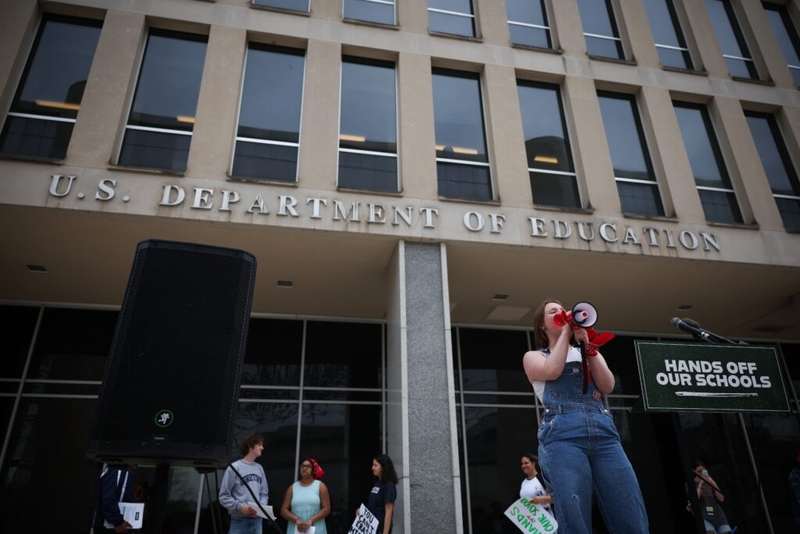 Description Students rally in front of the U.S. Department of Education building in Washington, D.C., in April to protest President Donald Trump’s efforts to dismantle the U.S. Department of Education. (Photo by Kayla Bartkowski/Getty Images) Parents deserve options. Every Michigan parent wants a safe school, excellent teaching, meaningful support for children with disabilities, strong literacy instruction, and a learning environment where their child can thrive. But should Michigan respond to the shortcomings of public education by investing more deeply in the schools required to serve every child, or help build a separate system that is less accountable to the public? For now, Michigan has not opted into the federal [Education Freedom Tax Credit program](https://www.ed.gov/media/document/education-freedom-tax-credit-fact-sheet-113147.pdf), and Gov. Gretchen Whitmer has not indicated whether she will make that decision before her term ends. That leaves Michigan with an important choice: protect and improve its public-school system, or participate in a federal tax-credit scheme that could further fragment it. The Education Freedom Tax Credit is not a conventional school voucher in name. Instead, it offers donors a federal tax credit up to $1,700 for contributions to approved scholarship-granting organizations. Those organizations can fund private-school tuition and a broad range of education-related expenses for qualifying students. Families are eligible only if their state’s governor chooses to opt in. [ ](https://michiganadvance.com/subscribe) This is not simply charitable giving. It is a major federal tax expenditure. The Joint Committee on Taxation estimates that the program will reduce federal revenue by roughly $26 billion over 10 years, with most of the cost coming after the program begins in 2027. Because Congress removed an overall annual cap, the final cost will depend on how many taxpayers participate. That is money unavailable for public purposes, including stronger schools, special education, child nutrition, transportation, and services for children living in poverty. Supporters say Michigan would be foolish to leave money on the table. They note that the scholarships could pay for tutoring, educational materials, and other services that public-school students might use without leaving their district. That is a reasonable point. In fact, the program differs from a traditional voucher precisely because it may reach some students enrolled in public schools. But a possible benefit for a limited number of families is not the same as a sound education policy for Michigan’s 1.4 million public-school students. Michigan public schools are already dealing with the financial consequences of declining enrollment. Statewide public K–12 enrollment[ has dropped ](https://crcmich.org/michigans-new-declining-student-enrollment-funding-policy-is-good-news-at-least-for-now)by 20% since the 2002–03 school year, and about two-thirds of Michigan districts experienced enrollment losses in 2025–26. Because Michigan funds schools largely on a per-pupil basis, enrollment losses mean less revenue — even though the cost of operating school buildings, transporting students, maintaining programs, paying staff, and providing special-education services cannot be reduced overnight. The Legislature recognized this pressure in the 2026–27 school budget. It created a temporary policy allowing certain districts to use a three-year enrollment average to soften the impact of declining student counts. But the measure relies on one-time funding and lasts only one year. The Citizens Research Council has warned that districts could face a funding cliff when that temporary help ends. If it opted into the federal program, Michigan would be encouraging a new pathway that may draw students and attention away from public schools while districts are struggling to maintain stable services for the children who remain. Public schools are not simply one choice among many. They are the only schools required to serve every child who comes through the door. They educate students with severe disabilities, students learning English, children in foster care, homeless students, students facing trauma and students whose families cannot afford private-school tuition, transportation, uniforms, technology or additional fees. Public schools must also meet public obligations. They operate under state academic standards, public budgeting rules, civil-rights law, special-education requirements, public-records provisions, and oversight by elected school boards. The federal tax-credit program does not itself require participating private schools to be accredited, conduct staff background checks, administer annual assessments, or meet several other safeguards that the public reasonably expects when public policy subsidizes education. That imbalance should concern every taxpayer, including those who support school choice. Should Michigan use public policy to steer resources toward institutions that can pick and choose students, charge families additional costs, and operate without the same transparency required of the public schools that serve everyone? The question is also one of priorities. Michigan’s latest M-STEP results make that question urgent: only 38.2% of third graders reached proficiency in English language arts, down from 38.9% the previous year. Will a federal tax credit for private-school scholarships improve reading outcomes for Michigan children? It does not directly strengthen literacy instruction, train teachers, provide interventions, or support the public schools responsible for serving every child. Michigan’s $22.9 billion education budget points t