Invasive zebra mussels have infested five percent of Minnesota’s treasured lakes, rivers and waterways, where they gobble up nutrients that native fish and plants need. So to keep them from spreading, the state’s Department of Natural Resources is using specially trained K-9s to sniff them out.
MPR News · Catharine Richert · September 8, 2026
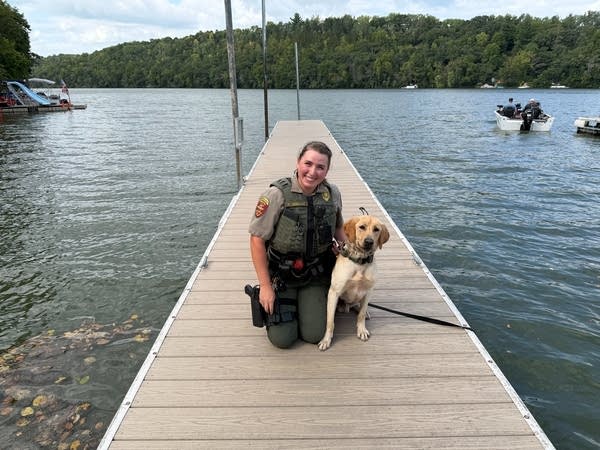
On a warm, late summer evening, Trapper the dog was hard at work at a boat launch on Lake Zumbro. The two-year-old yellow labrador retriever was sniffing each watercraft before it was launched into the water, hunting for little zebra mussels. He stuck his snout under Mike Hennessey’s fishing boat — and Trapper found nothing. That’s good news. Trapper is one of the newest members of a squad of K-9s that are specially trained by the Minnesota Department of Natural Resources to sniff out zebra mussels, an invasive species that, among other things, filter too much plankton and algae out of the water. That can reduce food supplies and nutrients for fish and other native aquatic life. Annette Schlag is a conservation officer for the DNR and Trapper’s handler. She said trained dogs are a useful tool in keeping zebra mussel populations under control. DNR Conservation Officer Annette Schlag holds a container of zebra mussels that are used to train dogs like Trapper to detect invasive species. Catharine Ricert | MPR News “A dog can detect something that we can't see because they can smell something that is hidden from sight,” Schlag said. And the dogs seem to disarm boaters who might otherwise be intimidated by a conservation officer approaching their boat. “When a dog comes out, people are a little more open to hearing why this is important and why taking the steps to make sure that they’re doing everything they can on their boat is important,” said Schlag. The K-9 detection program has been around for well over a decade, said Capt. Phil Mohs, who coordinates the DNR canine unit. Minnesota, he said, is one of three states nationally that uses dogs to detect zebra mussels, and it’s been successful. “The growth of our unit tells me that it's working,” he said. “I started as a supervisor in 2020. At that time we had had two zebra mussel detection dogs, and then it's now grown to where we're at eight,” he said. DNR conservation officer Annette Schlag and K-9 Trapper wait in the Lake Zumbro boat launch for people about to enter the water. Catharine Ricert | MPR News Mohs said that the goal of the program isn’t necessarily to issue citations to every boater who has mussels on the watercraft. It’s to help educate the public on the importance of checking their boats, to help prevent or at least slow the spread of the harmful invasive species. According to the DNR, zebra mussels have infested five percent of Minnesota’s lakes, rivers and waterways, and the DNR is trying to prevent people from unknowingly carrying the tiny zebra mussels from an infested body of water into one that is not yet infested. “If it’s one of those things where we can draw awareness and like, hey, this is an area now we've identified on your boat that you should probably check because the dog found zebra mussels here,” Mohs said. “That's what we're looking for is just to create that awareness and build that relationship where, you know, we get that voluntary compliance with the users.” Back at the boat launch on Lake Zumbro Schlag and Trapper let Mike Hennessey’s boat head to the water just as Aiden Rich of Rochester pulled up with a jet ski. DNR Conservation officer Annette Schlag and K-9 Trapper inspect a jet ski that's about to hit the water for zebra mussels. Catharine Ricert | MPR News Trapper took a sniff. He didn’t detect zebra mussels, but Schlag noticed the water plug on the back of Rich’s jet ski was still lodged in place. She explained that it’s illegal to transport a watercraft with the drainage plug still plugged in. “Zebra mussels are transferred through water. So, anytime there's potential of having water in a watercraft and not fully drained out and dried, that's an issue,” she told Rich. “Yeah, that's important to know,” said Rich, and told Schlag he’d unplug the stopper from now on. Instead of issuing Rich a warning or a citation, Schlag documented that she spoke with Rich and wished him good luck on the water, while Trapper happily wagged his tail and went on sniffing.