realtytoday.com · Lawrence Dubois / Published: Sep 08 2026, 4:11 PM EDT · September 8, 2026
A Federal Judge Just Blocked New York's $75 Billion Climate Fund. Here's What That Means for Flood Protection Money.
## The ruling striking down the state’s Climate Change Superfund Act removes a mechanism that would have charged fossil fuel companies $3 billion a year for coastal and infrastructure resilience projects, leaving New York to rely on a patchwork of smaller state and federal grants instead
By Lawrence Dubois / Published: Sep 08 2026, 4:11 PM EDT
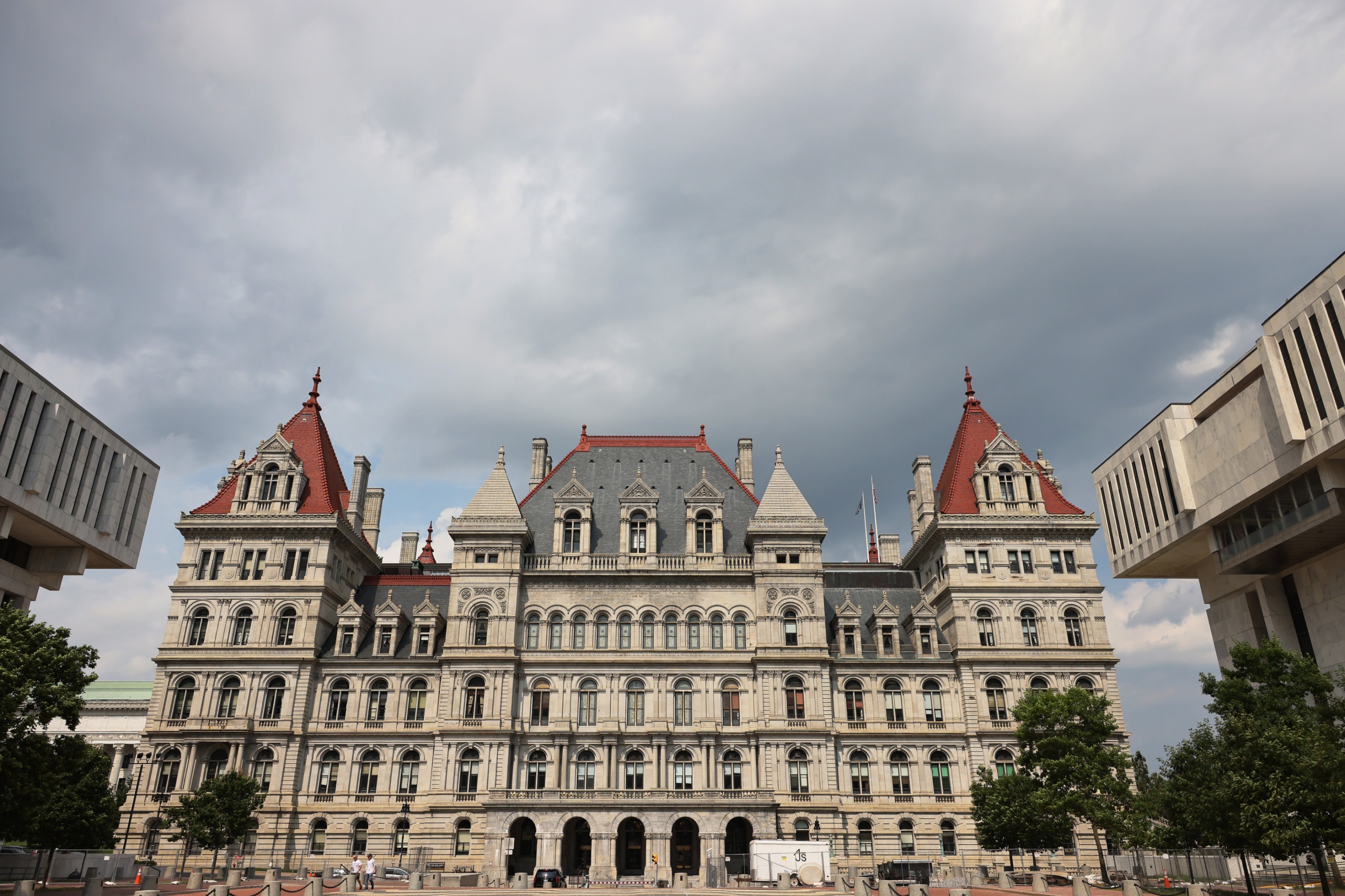
ALBANY, NEW YORK: The New York State Capitol Michael M. Santiago/Getty Images
New York's plan to charge major fossil fuel companies a collective $75 billion toward climate damage repair is dead, at least for now. U.S. District Judge Brenda Sannes ruled Monday that the state's 2024 Climate Change Superfund Act reaches into territory governed by federal law and conflicts with the need for a uniform national energy and environmental policy, striking down the statute in a decision that removes a funding source the state had planned to direct toward coastal and infrastructure resilience.
The law, signed by Governor Kathy Hochul, would have required companies responsible for substantial greenhouse gas emissions between 2000 and 2018 to collectively pay $3 billion a year over 25 years into a fund. That money was earmarked for projects meant to repair or prevent future climate damage, including coastal wetland restoration and upgrades to roads, bridges and water drainage systems, the kind of hardening projects that directly affect flood risk and insurance costs for property owners in vulnerable areas.
Sannes' ruling rested on two separate legal grounds. First, she found the law conflicts with the federal Clean Air Act, which designates the Environmental Protection Agency as the primary regulator of greenhouse gas emissions, and that New York's attempt to seek damages for the cumulative impact of emissions occurring "nearly everywhere on Earth" oversteps a state's authority into an area of established federal interest. Second, she found that attempting to collect damages from foreign fossil fuel producers specifically is preempted by the foreign affairs doctrine, a legal principle that reserves authority over international relations to the federal government, making that portion of the law unconstitutional on separate grounds.
The law was challenged by a coalition that included fossil fuel interests, business associations such as the U.S. Chamber of Commerce, 22 Republican state attorneys general, and the U.S. Environmental Protection Agency. The Trump administration separately sued New York directly, arguing the law amounted to state overreach into federal energy policy, part of a broader pattern: the administration has also challenged a nearly identical Vermont law and sued Hawaii and Michigan to block those states from pursuing climate damage lawsuits against oil companies. Adam Gustafson, a principal deputy assistant attorney general at the Department of Justice, said in a statement that New York's law "would have expropriated $75 billion from energy companies around the world during an energy emergency and in direct defiance of American foreign policy and federal law."
A spokesperson for Hochul's administration pushed back on the outcome, saying "taxpayers shouldn't have to foot the bill for damages caused by polluters," and confirmed the administration is reviewing the decision to determine its next steps. Climate advocates have urged an appeal, which would send the case to the U.S. Court of Appeals for the Second Circuit. Legal scholars tracking similar litigation in Vermont have said cases like this could ultimately reach the U.S. Supreme Court, a process that could take five to ten years to resolve.
For property owners and communities in flood-prone parts of New York, the practical question is what happens to resilience funding now that this particular $75 billion mechanism is off the table, at least while the case works through appeals. The answer, for the moment, is that New York's existing coastal and flood infrastructure spending continues, just at a much smaller scale and funded through different sources entirely. The state's $4.2 billion Environmental Bond Act, approved by voters in 2022, has funded roughly $450 million in resiliency-related grants this year alone, including a Community Resilience and Flood Risk Reduction Grant Program split between coastal rehabilitation projects and inland flooding mitigation. New York's Department of Environmental Conservation also administers the Resilient Watersheds Grant Program, which has run multiple funding rounds targeting flood and ice-jam risk reduction, and the state's Department of State has separately funded coastal lakeshore resiliency planning grants along Lake Ontario and the upper St. Lawrence River.
Those programs are real and ongoing, but they operate at a fundamentally different scale than what the Climate Change Superfund Act was designed to generate. The bond act's total $4.2 billion covers a broad range of environmental priorities beyond just coastal resilience and was always going to be spent down over multiple years, compared to the superfund law's proposed $3 billion in new annual revenue specifically earmarked for climate damage repair, sustained over a full 25-year period. New York City alone has separately pursued its own large-scale coastal protection projects, including a roughly $1.7 billion Lower Manhattan Coastal Resilience initiative and additional flood-wall and barrier projects extending along the East River, funded through a mix of city capital budgets and federal grants such as the Department of Housing and Urban Development's Rebuild by Design program, rather than through the state superfund mechanism.
Federal funding for this kind of infrastructure carries its own uncertainty right now. FEMA's Building Resilient Infrastructure and Communities program has historically been a significant source of hazard mitigation funding for states and municipalities, but federal resilience grant funding generally has faced disruption and reduced availability in recent budget cycles, according to reporting on the broader funding landscape facing coastal communities nationally. That leaves New York, at least for the near term, relying primarily on its existing bond act allocations, state environmental protection fund grants, and whatever federal funding remains available, rather than the dedicated, industry-funded revenue stream the superfund law was designed to create.
Whether New York ultimately finds another path to a large-scale, dedicated resilience funding mechanism, through an amended version of the law that survives legal challenge, a different funding structure entirely, or simply continued reliance on existing bond and grant programs, remains an open question the state has not yet answered publicly. What's clear is that the immediate effect of Monday's ruling is a funding gap between what the superfund law promised and what New York's current grant programs can actually deliver, a gap that matters directly to homeowners, businesses and municipalities in the state's most flood-exposed communities as they weigh their own resilience and hardening investments in the years ahead.