keystonenewsroom.com · Ian Karbal, Pennsylvania Capital-Star · September 8, 2026
Health experts, lawmakers push for Pa. kratom regulation; proponents warn they’ll fight a ban
# Health experts, lawmakers push for Pa. kratom regulation; proponents warn they’ll fight a ban
The substance has become a growing source of concern for addiction specialists, ER doctors, and public health professionals.
Ian Karbal, Pennsylvania Capital-Star
September 8, 2026
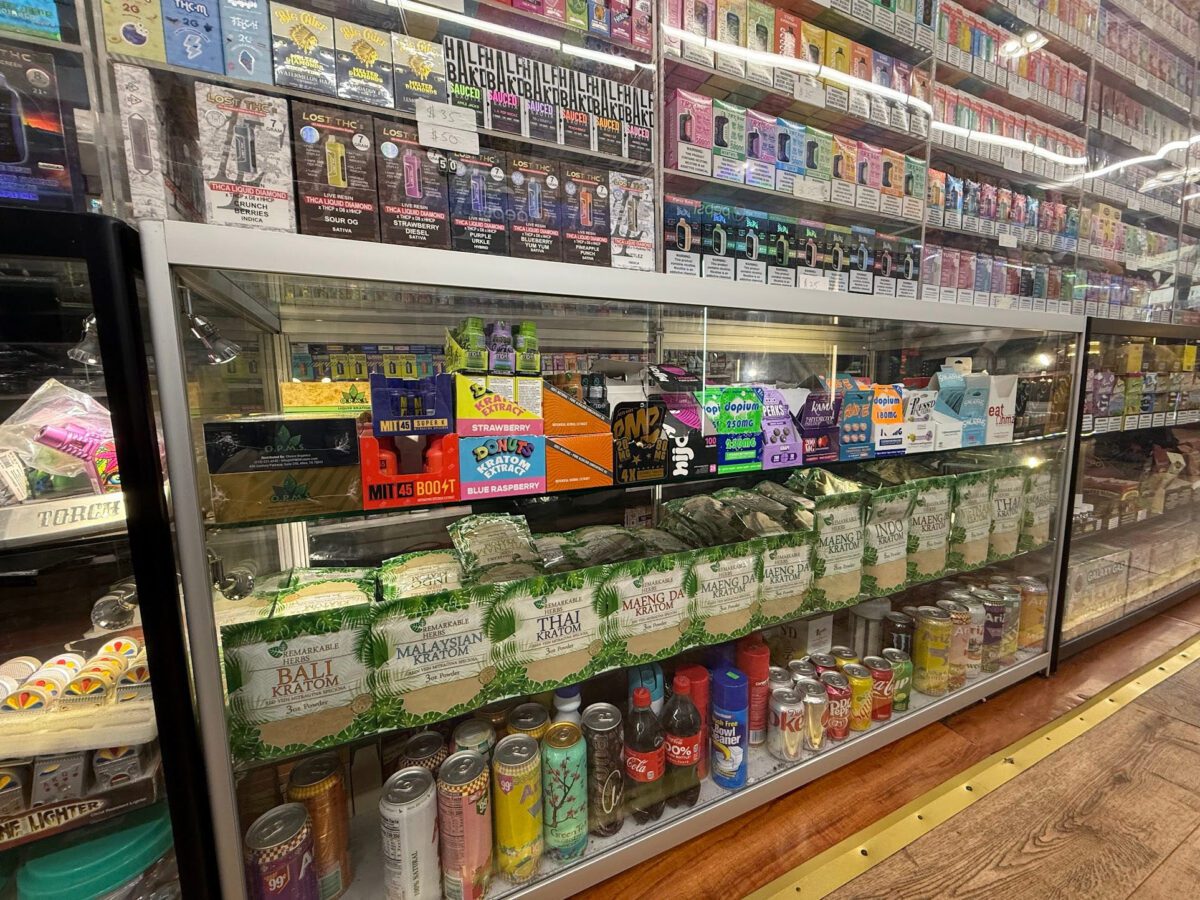
Powders, drinks and pills containing kratom and 7-hydroxymitragynine (7-OH) in a Downtown Pittsburgh smoke shop. (Photo: USA Today Network)
Sarah Kawasaki first heard about kratom around five years ago. It wasn’t through her work — she’s an addiction medicine specialist at Penn State, and the medical director of their associated opioid treatment program — but through her personal life.
“People would say, ‘Hey, what do you know about kratom?,’” she told the Capital-Star. “And I’d be like, ‘What?’”
So Kawasaki began looking into it. Kratom, she found, is an herbal supplement with opioid-like effects. In low doses, it can act as a stimulant, and in higher doses it produces a more sedative-like effect. Along with being a recreational drug, many users have reported using it to manage chronic pain or opioid withdrawal symptoms.
As her interest grew, she began to notice advertisements at smoke shops and other stores around her neighborhood. Then there were a couple of patients who acknowledged using it.
Fast forward to the present and Kawasaki has 10 to 20 patients in central Pennsylvania she is treating exclusively for kratom use, most of whom (around 80%) had previously sought treatment for opioid addiction and managed to kick the habit.
“Some people know that it can cause dependence and harm, and are intentionally using it that way,” she said. “But some people don’t. Then they get started on it and don’t realize they’re dependent until they stop.”
Kawasaki’s story is an increasingly common one in the world of addiction treatment. What, in America at least, was a little known substance, has become a growing source of concern for addiction specialists, ER doctors, and public health professionals — especially as potent extracts and synthetic kratom products become more widely available.
Increasingly, treatment centers are advertising their ability to treat kratom addiction. And as its popularity has grown, kratom has caught the attention of journalists, lawmakers, drug policy researchers, regulators, law enforcement and parents concerned about what their children may be exposed to.
In Pennsylvania, kratom and more potent, related products remain legal. There are multiple bills moving through the statehouse that would ban or regulate them. But researchers warn there’s still a lot they don’t know.
“Is it orders of magnitude less dangerous than fentanyl? Probably,” Kawasaki said. “But we don’t really know the definitive answer to that. We don’t really have a grasp on how many people are using it, or how they’re using it.”
“That should be alarming to anyone,” she added. “I don’t want people to put something in their body that they really don’t know what it is, or what it’s doing, or what’s even in the bottle, and trusting that more than they would an actual FDA-approved, quality-controlled medication.”
### What is kratom?
The plant kratom is made from is native to southeast Asia, where it’s been ingested for hundreds of years for medicinal, cultural, ritualistic and recreational reasons.
More recently, in America, kratom’s availability has boomed. Kratom and related products can be bought at gas stations, smoke shops and corner stores. That includes powdered forms of the leaf itself, highly potent extracts with stronger psychoactive effects, and lab-made synthetic products derived from its intoxicating compounds.
At the state and federal level, kratom and related products are hardly regulated.
Estimates for how many people in America have used kratom range from over one million to more than 20 million. But use is likely at an all-time high, and growing.
A r ecent study from the University of Michigan found that more than half of reported users have struggled with substance use disorder. Roughly a quarter reported having major depression, and around 38% experience psychological distress.
“It takes up a very complex space in the substance use landscape,” says Laura Nettuno, a researcher at the think tank RAND Corporation’s drug policy research center. “On one hand, for some people, it’s harm reduction because it helps manage opioid cravings and symptoms of withdrawal. But on the other hand, it’s creating its own issue.”
Nettuno points to the proliferation of kratom extract products, which are made from the kratom leaf, but have larger amounts of its intoxicating compounds, and more potent synthetic products. In particular, there’s 7-hydroxymitraynine, or 7-OH.
Mmitragynine is the primary psychoactive ingredient in kratom leaf, and 7-OH is found in trace amounts as well. But lab-made products with higher 7-OH concentrations are far more potent and addictive. Those have become more widely advertised and available in stores and online. And because there is so little regulation, it’s not always clear which kratom products contain higher amounts of the compound.
While kratom-related overdose rates are much lower than other opioids, there’s little research available on its negative health effects. Kratom products can also contain a host of adulterants that are unreported. And its half-life is much shorter than opioids like fentanyl, meaning regular users can go into withdrawal in a matter of three to six hours after taking it.
According to the Pennsylvania Department of Health, there have been 17 overdose deaths where kratom was a contributing factor in the state this year. That includes overdoses where kratom was found in a victim’s system along with other substances. There were 33 in 2025, but data is preliminary.
The number of Pennsylvania Poison Control Center cases related to kratom has also grown in the last two years. Last year, there were 114, including 25 involving 7-OH. This year, through June 30, there have already been 106, including 41 involving 7-OH.
“More potent synthetic products are coming out of these labs, and they’re tweaking them faster than regulation can keep up with,” Nettuno said. “And they’re also putting them on the market faster than our surveillance systems can keep up with. “It’s very much an open question whether kratom and kratom-related products are really harm reductive or not, because we just don’t know anything.”
That makes deciding how to regulate kratom uniquely difficult.
“Any researcher who is doing their job well should tell you we really have no idea,” Nettuno said. “We don’t have good data systems to track use-prevalence over time, and certainly not at granular, geographic levels, like in the state of Pennsylvania.”
“It’s clearly a public health concern,” she added.
What’s less clear, Nettuno says, is how to regulate it.
“The regulation is evolving very quickly,” she said. “Products and producers are responding to that very, very quickly, and we don’t know what that means in terms of what products are going to be on the market six months from now that don’t currently exist today.”
### Bills, bills, bills
In the last few years, Pennsylvania lawmakers have introduced a number of bills seeking to regulate kratom, though none have advanced to the governor’s desk.
Those with the most momentum would allow the sale of natural kratom leaf products to adults over 21, but would ban synthetic kratom products and some highly-potent extracts.
Rep. James Prokopiak (D-Bucks) is a co-sponsor on multiple bills.
“They really have the same end goal, which is providing regulation of both natural and synthetic kratom,” he said. “[They’re about] putting real guidelines on it, greater transparency in what the actual product is, and providing safeguards against children getting ahold of them.”
Both bills Prokopiak is co-sponsoring would ban