aberdeeninsider.com · Makenzie Huber for South Dakota Searchlight · September 5, 2026
Food Landscape Assessment Reveals South Dakota’s Gaps In Access, Affordability And Assistance | Aberdeen Insider
# Food landscape assessment reveals South Dakota’s gaps in access, affordability and assistance
By Makenzie Huber for South Dakota Searchlight - September 5, 2026 in Agriculture, News Reading Time: 4 minutes
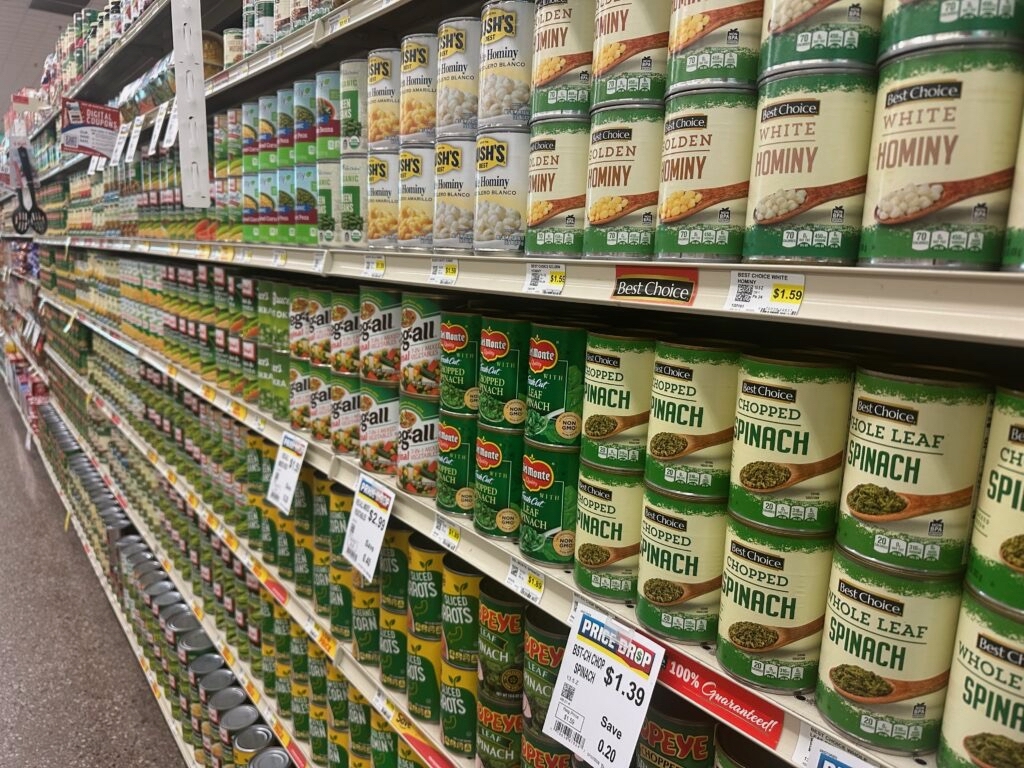
Canned foods stand on grocery store shelves. A recent study in South Dakota identified gaps in food affordability, access, assistance, availability and quality statewide. Iowa Capital Dispatch photo by Cami Koons.
In a survey weighted toward South Dakotans most likely to experience food insecurity, 30% indicated they were skipping meals to stay within their budget, according to the recently released South Dakota Food Landscape Assessment.
The assessment is the first of its kind in the state, identifying gaps in food affordability, access, assistance, availability and quality statewide. The information will give policymakers, lawmakers, researchers and community organizers a shared foundation to improve programs and drive policy changes, said Jennifer Folliard, principal consultant at Health and Nutrition First and coordinator for the South Dakota Healthy Nutrition Collaborative.
With the skipped meals and affordability information in hand, for example, the report recommends introducing produce prescriptions in South Dakota — a program that lets healthcare providers “prescribe” fruits and vegetables, redeemable at grocery stores or farmers markets. Other states have funded similar programs through Medicaid waivers, which allow states to use federal health insurance dollars in new ways, or through nonprofit funding.
## Community conversations
The South Dakota Healthy Nutrition Collaborative will host five community conversations about the South Dakota Food Landscape assessment findings:
- 5:30 p.m. on Wednesday, Sept. 16 at the Drifters Event Center in Fort Pierre. - 5:30 p.m. on Thursday, Sept. 17 at the Oyate Teca Project in Kyle. - 5:30 p.m. on Friday, Sept. 18 at the Journey Museum in Rapid City. - 5:30 p.m. on Wednesday, Sept. 23 at Avera St. Luke’s in Aberdeen. - 5:30 p.m. on Thursday, Sept. 24 at the University of South Dakota Sioux Falls campus.
The idea was discussed during the latest legislative session, Folliard said, when lawmakers approved a law that requires the state Department of Social Services to seek a waiver to ban soft drinks from the Supplemental Nutrition Assistance Program. The state submitted its waiver request on Monday, Aug. 31.
“When we were talking about SNAP restrictions, we also tried to raise the idea that if you restrict, it’s also good to incentivize healthy food,” Folliard said. “I think we can have those conversations next session a little bit more based on the data that came from this report.”
The state Department of Health has already designated child food sufficiency as a priority through its maternal and child health programs, providing momentum for the collaborative’s work, Folliard said.
The longer-term goal is a full food systems plan — a coordinated, statewide strategy for how food is grown, distributed and accessed, especially during times of economic stress. The collaborative is seeking funding to create the plan.
The assessment was produced through a partnership with the state Department of Health, Avera Research Institute, University of South Dakota’s Center for Prevention of Child Maltreatment, and the South Dakota Healthy Nutrition Collaborative. The collaborative brings together 40 organizations, including the state departments of Health, Human Services and Social Services.
More than 500 people participated in the assessment survey — including 217 community members (weighted toward South Dakotans most at risk of food insecurity based on age, geography and tribal affiliation) and 295 people involved in the food system, in fields such as healthcare, education, policy, etc. The assessment also included one-on-one interviews and focus groups.
Food security information is often scattered across agencies and organizations, Folliard said, making it hard for anyone to see the full picture.
“Food is at the base of all health,” said Folliard, who co-authored the assessment. “It’s everywhere, so no one’s taking ownership of it. The organizations that came together for this assessment recognized that we all have to play a part in figuring this out together.”
In South Dakota, according to the Centers for Disease Control and Prevention, 1 in 8 people and 1 in 5 children have limited or uncertain access to enough food, and 1 in 8 residents eat enough fruits and vegetables each day.
Those gaps don’t just affect individual health — they can drive up healthcare costs, strain schools and social services, and limit economic opportunity across the state, the assessment said.
In addition to affordability, the assessment included findings in key areas of food security and the state’s food system, including:
- Assistance: About 70,000 South Dakotans rely on the federal-state Supplemental Nutrition Assistance Program, and income cutoffs create a “benefits cliff” where earning slightly more can cost a family nearly $1,000 in monthly food assistance. - Access: 13 counties have food insecurity rates above the national average and 43 counties are considered food swamps, which are areas where dollar stores and convenience stores outnumber grocery stores. - Availability: 359 of South Dakota’s 28,299 farms are specialty operations growing the fruits, vegetables and whole foods that improve nutrition security.
The assessment’s data extends beyond the published report. The state Department of Health recently launched an interactive dashboard because of the assessment, drawing on several datasets — dollar store counts, diabetes rates, farm-to-school participation and SNAP vendor locations — that the department will update periodically.
That information gives local governments, community organizations and researchers the ability to examine their specific county and identify where targeted action is most needed, said Christine Hockett, director of community research at Avera Research Institute and a University of South Dakota associate professor who co-authored the assessment.
“When reports like these are published, a lot of times it happens once and then it’s like, ‘OK, what happens now?’ There’s no sustainability plan,” Hockett said. “As we were harmonizing and bringing the data together, we were doing it with the idea that we would ultimately share this with the Department of Health to make it accessible to everybody.”
South Dakota Searchlight is part of States Newsroom, a nonprofit news network supported by grants and a coalition of donors as a 501c(3) public charity. South Dakota Searchlight maintains editorial independence. Contact Editor Seth Tupper for questions: info@southdakotasearchlight.com.