Texas Standard · Raul Alonzo · September 9, 2026
On the campaign trail, the governor said dismantling city-owned utilities will save customers money by introducing competition.
By Paul Cobler, Texas Tribune September 9, 2026 10:00 am Energy & Environment , Government & Politics , The Texas Tribune Eddie Gaspar / The Texas Tribune
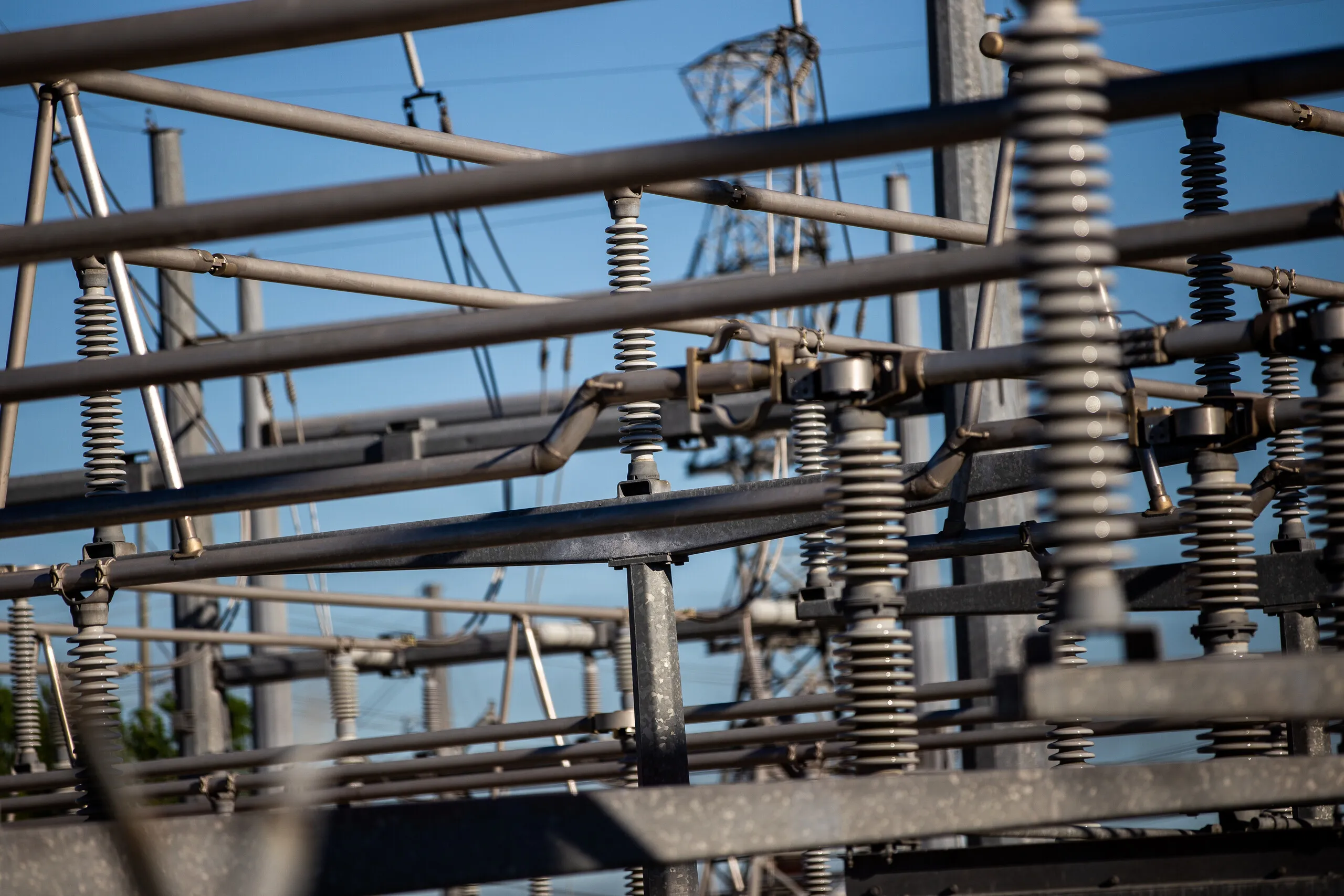
Details of electrical transformers at the Austin Energy/Sand Hill Energy Center in Del Valle on March 24, 2020.
The cities of Austin and San Antonio stand to lose hundreds of millions in revenue each year if a proposal by Gov. Greg Abbott to disband their energy utilities is enacted by the Legislature.
That’s the point, say supporters of the proposal, who argue that money should be going to lower customers’ electricity bills rather than city priorities.
San Antonio and Austin have the state’s two largest city-owned electric utilities, which say they offer among the cheapest electricity rates in the state because they operate as nonprofit electric companies that send every dollar they earn back to their communities, city and utility officials said. That money funds city services like libraries, parks and first responder operations, and the governor’s proposal would actually drive up electric rates for customers and be costly to enact, they said.
“Fundamentally changing our utility through deregulation would have broad and significant consequences to those we serve,” Austin Mayor Kirk Watson wrote in a statement, which touted Austin Energy’s affordability and reliability. “It would be a technically challenging, multi-year process and cost over a billion dollars that would be paid by customers.”
The governor’s campaign issued the proposal last month amid an election season focused on affordability, casting municipally-owned utilities as “utility monopolies,” and arguing the introduction of private competition will lower electricity prices. Statewide, electric rates have risen about 40% on average since 2020, up from an average residential rate of 11.50¢ per kWh in 2020 to 16.11¢ per kWh in 2026, according to data from independent electricity marketplace ElectricChoice .
Abbott said his proposal to end municipally-owned utilities will save 10% on the average electricity bill for Austin and San Antonio residents and small businesses even more.
“City-owned utility cartels should stop using ratepayers as a piggy bank to fund unnecessary social programs,” Abbott campaign press secretary Eduardo Leal wrote in a statement. “They should serve their customers, not the other way around.”
There are 72 municipally-owned utilities that provide power to 5.1 million Texans, or 15% of the state’s population, according to the Texas Public Power Association. Municipally-owned utilities own wires, poles and meter infrastructure and acquire and sell power to residential, commercial and industrial customers in their service area. They typically do hold a monopoly on the sale of electricity in their service area, but are nonprofits regulated and owned by their local government, whose oversight includes the setting of electric rates.
That not-for-profit model allows for the utility to keep rates low because CPS Energy is beholden only to San Antonio residents and not shareholders, CPS Energy said.
“As an organization that is owned and operated by Texans, our success supports regional jobs, energy resiliency, small businesses, customer assistance programs, and strengthens both the state grid and economy,” CPS Energy spokesperson Miguel Vargas wrote in a statement. “Any threat to the not-for-profit municipal model is a threat to all customers.”
Many Texas cities are f acing multi-million-dollar deficits caused by a sluggish economy, state-mandated caps on rising property tax revenues, rising inflation and the exhaustion of COVID-era federal funding. In San Antonio, the city faces a $158 million deficit over the next two years and Austin faces a structural deficit that could grow past $100 million by the start of the next decade. Stripping cities of their utility ownership could exacerbate budget woes.
Austin Energy transferred about $125 million to the city of Austin in 2025, according to Austin Energy. CPS Energy has budgeted a payment of $559.7 million to the city of San Antonio for fiscal year 2027.
In May, members of the Texas Senate Water, Agriculture and Rural Affairs Committee explored the common practice of municipally-owned utilities transferring excess revenue to the city that owns them. During the hearing, opponents of the model argued additional revenue should primarily be used for utility purposes, such as improving transmission infrastructure, not to pad cities’ budgets.
“We must address the cost of electricity that is putting a growing strain on Texas households,” Abbott wrote in an Aug. 3 statement. “That’s why I’m proposing legislation to end the monopoly control that cities like Austin and San Antonio have over electricity services and give Texans the freedom to choose the provider that works best for them.”
Experts and advocates say, however, it’s unclear if an end to publicly-owned utilities would lower costs for residential customers. A study of 2024 federal data by the American Public Power Association found customers of a public utility on average pay 14% less than customers of other utility types.
In Houston, the state’s largest city without a municipally-owned utility, customers are able to shop a variety of retail electric providers and choose the lowest rate. Separately, transmission and distribution utilities maintain the wires, poles, substations and meters that move electricity into homes and businesses.
Despite this deregulated environment, the Houston region experiences some of the highest electricity rates on the ERCOT grid. That’s attributed to the metropolitan area’s large population and limited local generation, which causes transmission congestion and raises prices, according to Houston-based energy consulting company Elite Energy Consultants.
“A business in Houston’s load zone might consistently pay $3-$8/MWh more than the ERCOT-wide hub price due to congestion — over a year, that adds up to thousands of dollars for a mid-size facility,” wrote Elite Energy Consultants CEO Apollo Kokkinopoulos .
Texas fully deregulated power markets in 2002. Under the legislation that deregulated the marketplace, existing municipally-owned utilities and electric cooperatives were given the option to join the competitive market or opt out, like San Antonio and Austin.
Since then, there have been efforts to rid the state of municipally-owned utilities entirely.
In 2023, state Rep. Ellen Troxclair , R-Austin, filed a bill to require public utilities to offer customers the opportunity to shop retail electric rates.
She filed it after a February 2023 ice storm knocked out power to hundreds of thousands of customers in central Texas for multiple days. Suburban communities just outside Austin that are served by Austin Energy but do not have Austin City Council representation, like the cities of Bee Cave and Lakeway, were particularly outraged, Troxclair said.
The incident sparked a local debate over the municipally-owned utility and its payments of excess revenue to the city. Troxclair, a former Austin City Council member, filed the bill that spring, which did not progress out of committee.
©2024 Texas Standard. A service of the Moody College of Communication at the University of Texas at Austin | Contact us