deseret.com · September 5, 2026
Is cloud seeding the answer to Utah’s water problems? | Opinion – Deseret News
## As Utah continues to be in severe drought, how effective is cloud seeding in solving our water problems?
Published: Sept 5, 2026, 1:00 p.m. MDT
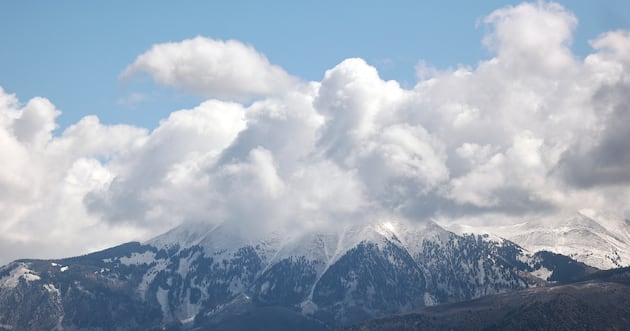
The La Sal Mountains are pictured on Tuesday, April 28, 2026. Kristin Murphy, Deseret News
By Nathan Murthy
Nathan Murthy is a 2026 graduate from the University of Utah, where he studied earth and environmental science and was a science writing intern for the College of Science.
In 2022, Utah made a drastic investment in cloud-seeding technology. Fueled by low Great Salt Lake levels and drought, the state increased funding from $350,000 to $5 million per year, along with a one-time investment of $12 million. Since then, the budget has risen to $7 million annually and $17 million in one-time funding.
About 30% of Utah’s dedicated cloud-seeding funding goes toward research, according to Jonathan Jennings, a meteorologist with the Utah Division of Water Resources. One project in particular could help answer a question that has persisted for decades: How much additional water does cloud seeding actually produce?
### How cloud seeding works
Winter storms in the Western U.S. can contain liquid water even when temperatures are below freezing. This supercooled water can remain liquid because it lacks an ice nucleus to initiate freezing.
Cloud seeding accelerates this process by injecting silver iodide (AgI) into clouds. The compound’s structure resembles ice, allowing it to act as an ice nucleus. Once ice forms, it can grow by collecting surrounding liquid water until it becomes heavy enough to fall as precipitation.
### From decades-old technology to modern research
Cloud seeding is not new. Bernard Vonnegut discovered in 1946 that silver iodide was an effective ice nucleus. Utah began formal cloud-seeding operations in 1973, but researchers struggled for decades to determine whether seeding produced meaningful additional precipitation.
“Until the 2010s, there was a lack of rigorous, statistically sound, peer-reviewed studies on cloud seeding,” said Peter Veals, an atmospheric scientist at the University of Utah.
One major attempt to address this gap was the Wyoming Weather Modification Pilot Program. After six seasons of seeding in the Medicine Bow Range, researchers estimated a 3% increase in precipitation during seedable storms. However, natural variability was too large to rule out that the increase occurred by chance.
Then came the 2017 Seeded and Natural Orographic Wintertime Clouds: The Idaho Experiment, or SNOWIE. Using mobile radars, researchers detected snowfall generated along the path of a cloud-seeding aircraft, providing strong evidence that seeding could physically produce additional snowfall. SNOWIE was a “game changer,” Veals said.
But an important question remained: How much additional water does that snowfall ultimately contribute?
### Measuring the impact
To help answer that question, the Seeded Natural and Orographic Winter Storms and Catchment Processes Evaluation, or SNOWSCAPE, began in 2025.
The project brought together researchers from the University of Utah, Utah State University, the Utah Division of Water Resources and the National Center for Atmospheric Research. Along Utah’s Ogden Valley, researchers deployed mobile Doppler radars, weather balloons, microwave radiometers and particulate sensors to measure storm structure and composition. Precipitation gauges measured the effects of seeding on the ground. Rainmaker, a weather modification company based in El Segundo, California, conducted remote seeding operations.
From January to March of 2026, researchers collected data from 11 winter storms. Those observations are now being used in weather models to simulate multiple seasons of seeded and unseeded winters.
“Taking it to the next step — the hydrological cycle — is something that the cloud seeding industry has been missing for decades,” Jennings said.
Not all precipitation becomes streamflow. Water can evaporate, enter groundwater storage, or be used by plants. SNOWSCAPE researchers will use tritium, a naturally occurring radioactive isotope of hydrogen, to help determine how long water takes to move from precipitation to flowing rivers. Snow samples will also be analyzed for aerosol deposition from cloud seeding.
### A tool, not a solution
Jennings cautioned against viewing cloud seeding as a solution to Utah’s water problems.
“Cloud seeding is a tool … and it’s not the tool that is going to refill the Great Salt Lake by itself,” he said.
SNOWSCAPE’s value may instead be in determining how effectively that tool can be used. By measuring the entire path from cloud formation to precipitation and eventually streamflow, researchers hope to determine not simply whether cloud seeding works, but how much additional water it can provide.
At a moment where Utah is spending millions of dollars annually on the technology and 93% of the state is facing severe drought or worse, that distinction could be critical.